
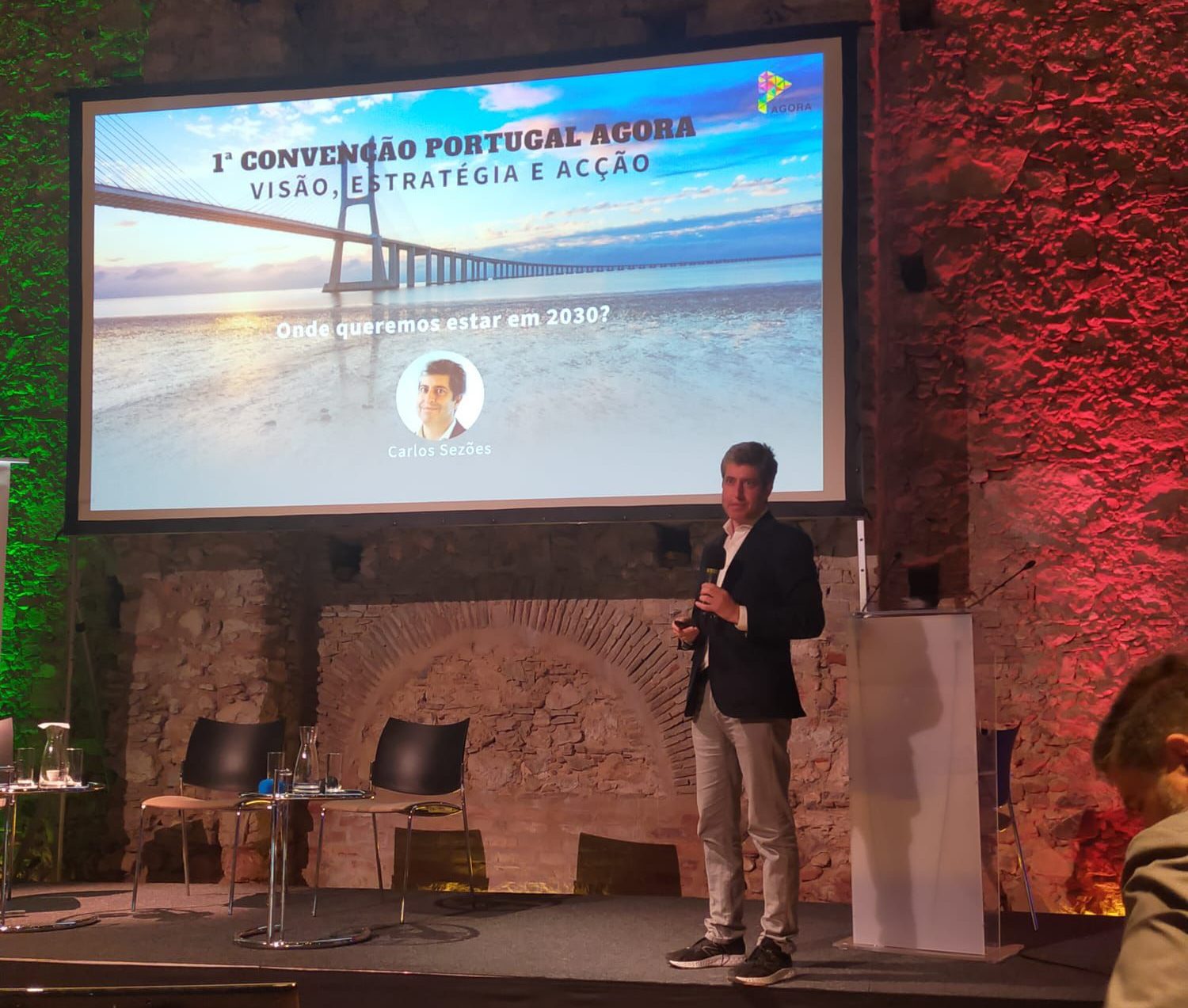
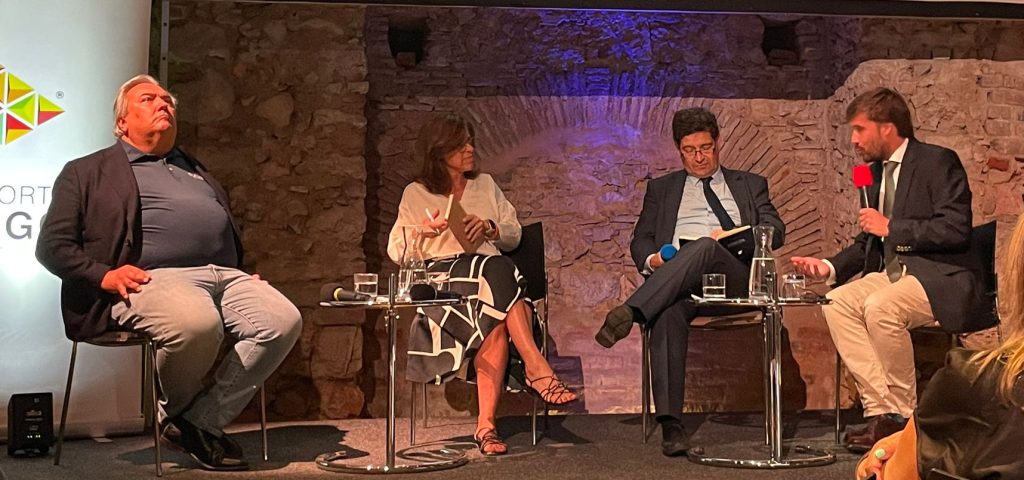
This Thursday, June 27, the 1st Convention Portugal Agora – Vision, Strategy, and Action provided an overview and a presentation on the project in itself, and to our country's current and future performance in various areas.
Opening:
Carlos Sezões and Luís Salvado opened the event with a brief introduction and overview of the project, Portugal Agora, and the topics that would be discussed.
Is Portugal still an attractive destination?
In the first panel, “Portugal remains attractive?”, Diogo Agostinho moderated the discussion between José Botelho, António Ramalho, and Cristina Siza Vieira.
The topic was discussed and debated by the three speakers, each offering their own perspective on the current Portuguese territory and each sharing their views from the standpoint of their respective professional fields.
A consensus has been reached that, financially speaking, Portugal is not among the most attractive countries; nevertheless, Portugal offers unique conditions for developing sectors such as tourism. To a large extent, this is used pragmatically to promote national recognition, as well as to generate value and foster international partnerships.
Does Portugal foster learning and talent?
During the second panel, “Portugal fosters learning and talent?”, Ana Leonor Martins moderated the conversation between Paula Branco and João Duque.
In this section, we began by addressing the fact that, currently, a large number of young people prefer and seek out vocational programs.
This development is also due to the fact that vocational programs provide a pathway to the job market, and at the end of high school, students who have been properly trained can choose between entering the workforce or continuing their studiesof.
João Duque states that Portugal currently benefits from greater corporate motivation on the part of various organizations, which are committed to helping modernize and advance the country’s education system. Schools are increasingly adopting new technologies; they are becoming more up-to-date and aware of new tools, such as artificial intelligence.
Paula Branco closed the panel with a statement: “You can only evolve if…””You can do anything when you're determined to do it.".
Does Portugal produce innovation?
During the third panel, “Portugal Drives Innovation?”, Leonor Pipa moderated the conversation between António Lucena Faria, Hugo de Sousa, and Raquel Caldeira.
Artificial intelligence was a major topic of discussion during this panel, as it is one of the most impactful innovations of recent decades.
It is true that innovation must take place internally or externally within the business sector, through the exchange of ideas to generate business opportunities, and it will clearly be evident just how indispensable artificial intelligence will be to us moving forward. What will make all the difference is knowing how to ask the right questions to achieve results in artificial intelligence.
Hugo de Santos stated that there are tools for exploratory research that aid in the innovation development process.
He then gave an example: Vasco da Gama was an exceptional entrepreneur; without any concrete certainties, he risked everything to discover another continent, and used navigational instruments in his “indecisive quest,” which helped him stay on course and discover land. In the business world, the concept is to recreate that same instrument in order to address the need for innovation in a specific area.
For a more innovative Portugal by 2030, senior and middle managers must think about the future and invest in culture, awareness, and training.
Is Portugal resilient in the face of global uncertainty?
In the fourth panel, “Portugal is resilient in the face of global uncertainty?”, Joana Petiz moderated the conversation between Bruno Horta Soares and António Nabo Martins.
This panel began by clarifying that foresight and resilience are fundamental to preparedness, which in turn is shaped by perception—a process that can be facilitated depending on the context.
Bruno Soares states that we have two options: “Either we change reality or we change the theory.” This point was discussed at length during this panel, and, generally speaking, it was argued that we—businesspeople, entrepreneurs, futurists, etc.—constantly find ourselves having to choose between living in reality or living in theory, and this mindset must change.
Bruno Soares also pointed out a case of apprehension regarding the shift from paper-based bureaucracy to digital bureaucracy.
What usually happens is that there is a strong tendency to want to pay as little as possible and in the short term, and that certainly does not demonstrate much control over resilience.
We should focus on public housing or health policies, rather than on public housing or health policies. It was suggested that the use of cloud computing and infrastructure consolidation be employed to modernize the government, ensuring cross-cutting coordination and compliance among the various agencies.
Conclusion from Portugal Agora:
Carlos Sezões presented the project's findings—that is, he identified several key areas that are crucial for a more advanced and efficient Portugal in 2023.
How?
Through national consensus-building efforts involving the government, universities, companies, business associations, foundations, local governments, and others.
What's the strategy?
Drawing on supply chains, environmental sustainability, cybersecurity, health and well-being, and institutional agility, the goal for a Resilient Portugal will be;
- Exemplary implementation and processes in land management and environmental sustainability;
- Promoting supply chains that mitigate global risks;
- An agile government and institutional and digital resilience to ensure minimum security levels.
By leveraging social promotion, legal and tax incentives, scale and sustainability, financing, and education and training, we will ensure that Portugal Becomes More Entrepreneurial;
- Widespread promotion of critical thinking, entrepreneurship, creativity, and innovation;
- Establishing an attractive legal and tax framework that draws capital and fosters the growth of startups and scaleups;
- A globally oriented economy;
- By strengthening education, scientific research, innovation applied to the economy, academic training, and lifelong learning, we contribute to a A More Knowledgeable Portugal;
- Systems focused on learning and skills;
- With world-class research and innovation centers (primarily in high value-added technologies);
And to make Portugal: More Attractive There's nothing better than taking a chance on tourism and events, professional opportunities, academic opportunities, residential opportunities, and investment.
- Open, welcoming, cosmopolitan, a model for the integration of immigrants;
- Focused on attracting talent;
- Focus on premium and sustainable tourism;
- Universities with a global outlook.
What is the vision?
Make Portugal ----- The best country in Europe to live and work in!