
Given the particular importance of B2B (“Business-to-Business”) exporting companies to economic growth—especially in light of the goal for Portuguese exports to reach 50% of GDP by 2027— it is important to understand how these companies view their communication strategies, what trends are shaping the market, and what avenues are opening up for more competitive and successful communication management. This comes at a time of profound transformation in how companies reach their “stakeholders” and position themselves in the market.
The study “InterComm Report – B2B Communication Trends in Global Businesses (InterComm),” conducted by School of Communication The Social Department of the Lisbon Polytechnic Institute and SayU Consulting – Evoke Network, with support from aicep Portugal Global, present an overview of the role of communication in building and managing relationships with stakeholders of Portuguese organizations that focus on sales to other companies and relevant international businesses.
In addition to providing a study that identifies trends, InterComm also aims to foster reflection and action by highlighting ways to address current and future challenges.
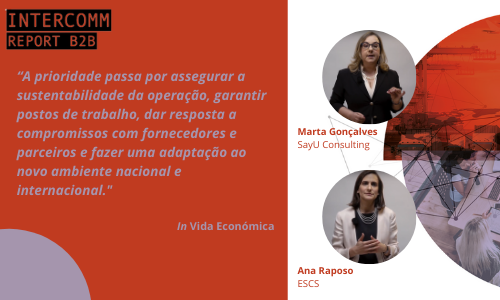
Faced with challenges that have threatened the survival of companies, the priority is to ensure the sustainability of operations, safeguard jobs, fulfill commitments to suppliers and partners, and adapt to the new national and international environment. At the same time, it is also necessary to plan for the future so that this scenario does not repeat itself without a prepared response.
In communication, there is a fundamental concept: context. As the current situation evolves and we come to understand the reality that companies are facing, we will need to combine possible solutions and find the best strategy for reaching the audience. We also believe that the frequency and channel through which interactions take place can be adapted, but the critical factor remains the same: the relationship, which is the foundation of B2B business and the key to a company’s success.
That is why it is more important than ever to talk about communication. Communication is sometimes understood as merely the transmission of information between a sender and a receiver. Managing communication is, in fact, managing interaction and seeking dialogue and negotiation to achieve a specific goal. It is communication that enables companies to give meaning to and add value to their relationship with the market and to support a set of processes that form the foundation of B2B: trust, credibility, cooperation, clarity, and knowledge.
Communication is crucial for B2B companies in global markets. The situation we have been experiencing for over a year has made it clear that it is time for top management to understand how communication helps companies become more competitive.
Given current trends, the need and importance for companies to intentionally build and manage relationships with the various stakeholders in their value chain are now more evident than ever. Communication, understood as a comprehensive strategic function, enables companies not only to sell products and services but also to gain visibility and build a strong reputation, making them more successful in achieving their business goals.
Defining a strategy and properly establishing outreach and communication channels will foster a lasting and ongoing relationship with the public and help build trust. In the current context, investing in building this trust is crucial and promises to be a key competitive advantage in the post-pandemic world. Investing in building this trust is crucial and promises to be a key competitive advantage in the post-pandemic world.