
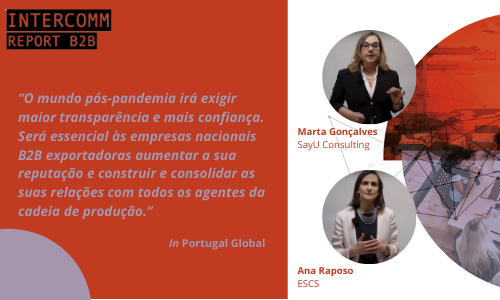
The findings of the InterComm Report – B2B Communication Trends in Global Businesses (InterComm) study were presented yesterday. The study was conducted by the School of Media and Communication at the Lisbon Polytechnic Institute and SayU Consulting – Evoke Network, with support from aicep Portugal Global. In addition to identifying trends, this study aims to facilitate action by offering various perspectives on the role of communication in building and managing relationships with stakeholders of Portuguese B2B export companies.These companies make a significant contribution to the country’s economic growth, and, according to the study, their success lies in effective communication. This effectiveness involves enhancing their reputation and building and strengthening their relationships, showcasing innovation, fostering synergies and trust, and cooperating through dialogue and negotiation. The study outlines several possible paths for effective action in global markets.
Communication gives a voice to products and services, represents brands, and builds brand awareness in global markets. In times of heightened noise like those we are currently experiencing, communication serves as the “voice” of brands, inspiring confidence in times of uncertainty and serving as an anchor for organizations’ relationships with the market. In foreign markets, where companies are still seeking to establish a foothold, it is essential to build brand awareness and a strong reputation through communication initiatives that contribute to commercial and operational growth.
Communication adds value to operations in global markets. A company’s reputation in the market depends not only on the quality of its products and services, but also on a combination of various factors, such as its history, mission, vision, values, achievements, past experience in the industry, and investment plans, among others. All of these elements are crucial and must be shared to build “trust capital” and visibility among the various stakeholders.
A successful communication plan makes it easier to enter a particular market. Telling a compelling, exciting, and convincing story is just as important today as it has always been, and a good, well-told story continues to make a difference, regardless of the nature of the brand.
Reputation management and consolidation are also part of this process, helping to communicate the company’s identity and values to everyone stakeholders. In a B2B context, the client is a partner with whom it is necessary to build and manage a relationship based on trust from a medium- to long-term perspective. It therefore makes more sense to view communication as the management of relationships with partners, thereby building the desired reputation.
The pandemic and its aftermath will continue to test the resilience of people and organizations. But there is a future focused on building a recovery together, based on tools, instruments, and teams that can achieve what we might call Restart for companies in a new context. The focus must be on the ability to strengthen partnerships and transform relationships with stakeholders. This opportunity requires agility at all levels, as well as a great deal of flexibility, adaptability, and persistence—which will only be possible with well-structured and focused communication.
Communication is crucial for B2B companies in global markets. The situation we have been living through for over a year has made it clear that it is time for top management to understand the role that communication can play in making companies more competitive. It is possible for a company to survive without communicating, but it will be more efficient if it intentionally and strategically manages its communication processes with its various stakeholders.
According to Ana Raposo and Marta Gonçalves, the researchers in charge of InterComm, "The post-pandemic world will demand greater transparency and more trust. It will be essential for domestic B2B exporters to enhance their reputation and build and strengthen their relationships with all stakeholders in the production chain, from the supplier of raw materials to the end customer (the buyer), including all other stakeholders, such as employees, partners, regulatory agencies, and the government.".
InterComm brings together, in a complementary manner, domestic and international business experience, academic and technical knowledge, statistical data, and insights into the target market, through a survey of more than 120 domestic B2B exporting companies from various sectors, of different sizes and at various stages of development.
See more information here.