
Digital: The specific challenges posed by the current crisis have led to a profound shift toward digitalization in business operations. This boost Technological transformation was already on the horizon for many organizations, but it has now emerged with a heightened sense of urgency and a faster pace of implementation, and it promises to leave behind those who do not make an effort in this direction.
Alongside the focus on e-commerce, there is also a growing digitization of communication processes. The demand for alternative ways to purchase products and services has given rise to a consumer who seeks innovation and craves more disruptive and efficient solutions.
This transformation will make it impossible to return to the past. The new opportunities now created promise more chances to work in partnership and in a holistic manner, with established contacts with stakeholders across various sectors, geographies, and on countless platforms.
The companies surveyed as part of the “InterComm Report – B2B Communication Trends in Global Businesses (InterComm)” study cite the website as the most commonly used communication channel for communicating with various stakeholders, having been selected by 90.3% of respondents. Email (85.4%) and social media (80.6%) also emerged as significant channels. Digital channels made it possible to find different points of contact given the inability to travel and work as usual.
This raises the question of how digital media is used—whether in a static, one-way manner or in an interactive, two-way manner, as is expected in genuine and effective communication.
Although it offers new opportunities, digital transformation is not the solution for the B2B companies analyzed in this study. It is not enough to launch a website or an e-commerce platform or to create social media channels, because these organizations do not sell to end consumers.
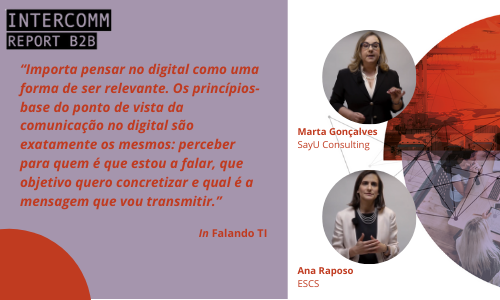
It is indeed important to think of digital as a way to stay relevant. We believe that the basic principles of digital communication are exactly the same: understanding who I’m talking to, what goal I want to achieve, and what message I’m going to convey.
To become relevant, we need to know how to tell stories and find our unique selling point, building our brand and using campaigns and communication initiatives that explain who we are and why people should trust us. It’s important to (re)evaluate our relationships with all stakeholders and the channels where there are the most results. The value proposition must be creative and disruptive.
When we talk about “digital” tools, what we really mean is that they are developed through more technologically advanced and dynamic channels. Nothing is lost in terms of the communication’s identity. What changes is the fact that we build relationships with customers, partners, decision-makers, and various entities through new solutions and methodologies. Ultimately, this drives traffic to a website, highlights a message, and, as a result, strengthens the brand and organization’s presence.
The way we interact with one another has changed with the digitization of our relationships. Strategies for Communication must keep pace with this transformation.
In IT Talk